
Walk in not knowing what to work on. Walk out with a named, validated direction and your first move. Five short modules, seven plug-in AI prompts, one finished North Star page.
Start the Workbook →A Quick Word, Then We Get to Work
You already know me from the Playbook, so I'll skip the life story. The part that matters for this: I've reinvented myself more than once. Foundry worker, then 17-year draftsman, now a guy who gets paid on his own terms. None of those turns followed a tidy formula. They came from years of research, trial and error, and a pile of dead ends. Most of it long before AI was even around to help. This workbook is the culmination of what I learned the hard way, boiled down to a handful of thought exercises. AI just does the part it's actually good at: speeds up the thinking. (One of these prompts is the one a reader told me "may have saved my career.")
One bias I should name. I'm not chasing the biggest thing. I'm building the calmest thing that still pays well, and I'll be nudging you the same way. That comes from a book, Company of One by Paul Jarvis. A few years back it stopped being something I read and became my operating system. Success is more freedom, not more growth. Design the life first, then build the business that funds it. Small, owned, and profitable beats big and panicking.
So when this workbook keeps steering you toward something AI-proof, something you own, and something you'd do anyway, that's the lens. If your dream is to build an empire and sell it for millions, this can still help. Just filter my advice accordingly.
Two things, so you get your money's worth:
- Actually do it. Reading won't move you. Filling in the box, running the prompts, and writing your North Star will. Block off an hour and a free AI account, and you'll walk out with it done.
- Be honest in the inputs. The AI is only as sharp as what you feed it. Rough and real beats polished and vague every time.
And my promise: do the work, and if you don't walk away with a direction worth building toward, email me at coreysretirement@fastmail.com and I'll refund every penny. No questions, no hard feelings. The risk's on me.
Fill It In Once. The Whole Thing Builds Itself.
Every module has a short read, a quick exercise, and a copy-paste AI prompt. You'll fill in your raw materials one time in the box below (your age, your roles, your skills, the rest), and it drops into every prompt automatically. No retyping. No digging.
For each prompt, hit Copy, paste it into ChatGPT, Claude, or Gemini (a free account is fine), and answer what it asks. The outputs stack, module by module, into one finished "My North Star" page at the end. You leave holding a document, not a vibe.
Don't make it pretty. This is just raw material we'll match to real opportunities later. Type rough notes. It saves automatically as you go.
Mine Your Experience: The 25-Year Asset Inventory
The raw materials are already in you. First we get them on paper.
Here's a line I overheard on a podcast that changed how I see work: "We are all just storytellers and toolmakers."
Strip any career down and that's what's left. We run into problems. We build or borrow tools to solve them. Then we tell the story of how we solved them, to help the next person. That's not just work. That's the whole engine of getting paid on your own terms.
Which means your 25 years isn't a sunk cost you're walking away from. It's a deposit. A pile of problems you've already learned to solve that other people are still stuck on. The trouble is you've solved them so many times you've stopped noticing they're worth anything.
So before we aim anywhere, we lay it all out on the table. You already started. That's the box up top. The four-part brain dump is exactly what's in it: your roles, the tools you know, the projects that made or saved money, and the hobbies where you've quietly gotten good. If you skipped it, scroll up and rough it in now. It feeds everything below.
With your raw materials filled in above, run them through the prompt below. It uses the problem → tool → story framework to surface marketable problems you solve that you've stopped seeing. Copy it, paste it into your AI, read what it hands back.
A written inventory of your marketable assets. Concrete proof, on the page, that you're not starting from zero.
Aim Where AI Can't Follow: The Rory Test
Don't build a future on ground that's about to disappear.
Before you fall in love with any direction, you pressure-test it against one question: can a machine do this cheaper than you next year?
There's a map for this. I sketched it in my notebook one weekend. It's called the "AI-Proof Quadrant" (credit to Perry Marshall). Two axes: Productive ↔ Unproductive and Predictable ↔ Unpredictable. Three of the four corners are the kill zone:
- Unproductive & Predictable: bureaucracy, middle management, admin. AI takes this easily.
- Productive & Predictable: coding, data entry, logistics. AI takes this.
- Productive & Unpredictable: strategy optimization. Agentic AI is eating this faster than anyone expected.
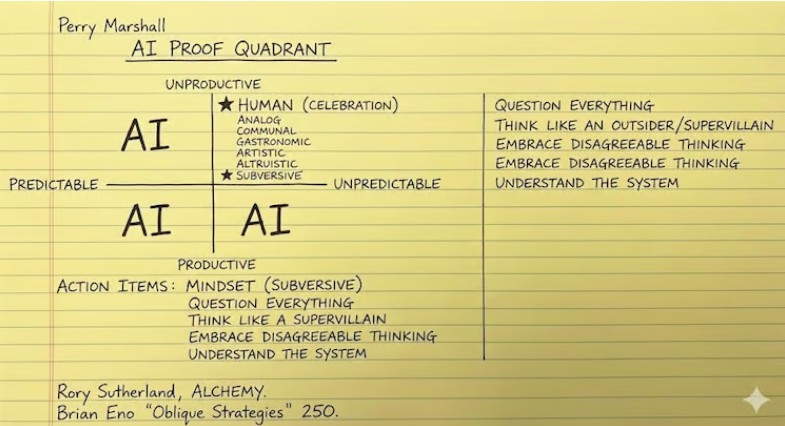
That leaves one safe harbor: the top-right corner, Unproductive & Unpredictable. The human zone. Corporate culture hates it because it looks like waste. But it's the only ground the robots can't take. Perry's six traits that live there: analog, communal, gastronomic, artistic, altruistic, and subversive.
That's why your 25 years matters here. Experience and judgment live in the safe harbor. The trick is angling your direction toward the human zone instead of straight into the kill zone. And for that, we borrow a brain.
Meet Rory Sutherland. Vice Chairman of Ogilvy, author of Alchemy, master of the unproductive/unpredictable quadrant. His whole thing: the modern world is obsessed with logic, but humans aren't logical, we're psychological. (Logic says make the train faster for $6 billion. Alchemy says put WiFi on it for $50 million so people enjoy the wait.) We're going to let an AI play him.
Step 1: Education. First, let the AI teach you the framework so the next answer actually lands. Copy this, paste it, read the reply.
Now turn that lens on your own direction. Type the role, idea, or candidate direction you want to pressure-test, then copy the prompt.
"Corey, this column may have saved my career. The AI Rory prompt helped put something in perspective for me about my new job and guided how I'm going to approach it going forward. I can't explain it without giving you a ton of detail, but I just wanted to say thank you!"
Your asset list, filtered and re-angled. Now you know which directions are durable and which to walk away from before you sink a year into them.
Find the Crosshairs: Your Ikigai Intersection
Where what you love, what you're good at, what's needed, and what pays all meet.
Everyone tells you to invest in your 401(k). Nobody tells you to invest in yourself. But the best investment you'll ever make is the one with the most control over how much comes in and how long it lasts. That's you.
There's a Japanese concept that maps the sweet spot: Ikigai, your "reason for being." It sits at the overlap of four circles:
- Passion: what excites you.
- Proficiency: what you're good at.
- Mission: what the world needs.
- Vocation: what you can get paid for.
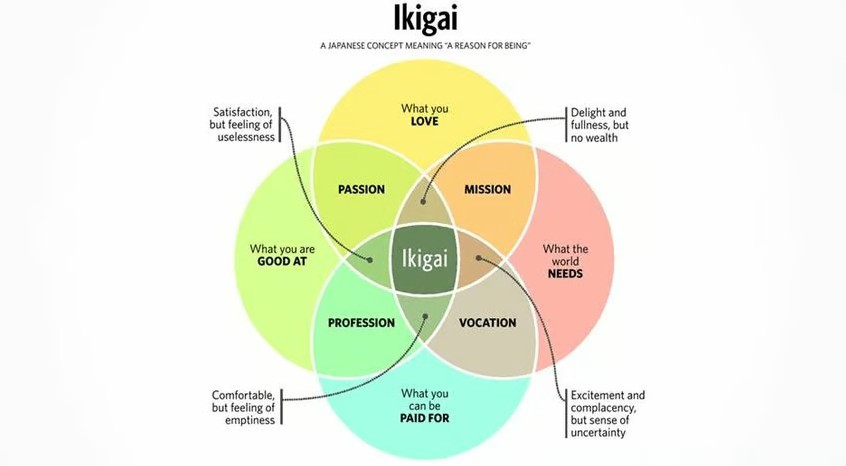
Any one circle on its own is a hobby, a job, a cause, or a paycheck. The magic is only where all four overlap. That's the direction that survives the long haul, because it passes the "work you'd do anyway" filter. Like they say: if you like what you do, you never work a day in your life. That's the test. We're picking something you'd happily still be doing in 15 years, retire or not.
When I ran this exercise on myself, the AI spit back ideas I'd quietly already made money on without realizing they were connected: music marketing, CAD training, Google Ads consulting. It knew nothing about me except what I typed. That's how accurate this gets when you let it interview you properly.
This one's a conversation, not a one-shot. Paste the prompt and the AI will interview you. Keep answering its questions honestly until it's confident enough to name where your four circles intersect profitably.
Push it to really interview you. Answer in full sentences, not one-word replies. If it jumps to ideas too fast, push back: "Ask me 5 more questions before you answer." The more it digs, the sharper the directions it lands on. When it finally names them, ask: "Which of these could I start this month while still employed?"
1–3 candidate directions sitting in your personal sweet spot. The question stops being "what should I do?" and becomes "which of these?"
Turn Your Direction Into Income: Three Ways to Get Paid
A direction isn't an income. Here's how it becomes one.
You've got a direction. Now comes the part that pays the bills: turning it into income. For solo online income, there are three main ways to do that. Not literally every way to earn a living, just the three that fit a full-time professional testing something on the side. Pick the one that fits where you're at right now. You can add the others later:
- Path 1: Freelance it. Sell your time. Often the fastest path to real money for mid-career professionals, because you're renting out skills you already have.
- Path 2: Package it. Sell something you create once (a course, a template, a product). More work up front, but it can keep selling while you sleep.
- Path 3: Build an audience. Start a newsletter. It usually pays the least at the start and has the highest potential ceiling, because it's the one audience asset you truly own. Not a follower count you rent from an algorithm that can cut your reach overnight.
- Want extra cash in the next 30–90 days and already have work experience? → Start with Path 1 (Freelance).
- Like creating things and can wait a bit for the money? → Path 2 (Package).
- Care about long-term freedom and don't mind slow results? → Run Path 3 (newsletter) in the background while you work on Path 1 or 2.
First, Check Real Demand
Don't guess at demand. Go look at it. And the move most people miss: you don't need a different method for each path. Run your skill (or your topic) through a quick keyword search and you'll see demand for all three paths at once.
Back when I was a draftsman, one afternoon of searching told me plenty. Roughly 3,600 people a month were searching "drafting services" (Path 1, folks who'd hire me). Another 22,000 a month searching "AutoCAD courses" (Path 2, folks who'd buy a course). And a steady stream looking for industry how-to (Path 3, folks who'd read a newsletter). One search, three signals.
A few free ways to read it:
- Ubersuggest (free). Type in your skill or topic and see how many people search it each month.
- Google Trends (free). Is interest rising, flat, or fading?
- Plain Google. If you see sponsored ads on a term, businesses are paying to show up there. That's a profit signal.
- Marketplace reviews (Udemy, Amazon). Rough rule: only about 10% of buyers leave a review, so multiply the review count by ~10 to estimate buyers. A course with thousands of reviews is proof people pay.
Here's me walking through the whole thing on my old draftsman background, finding real opportunity with nothing but free Google tools:
Free-tools demand check, start to finish, using my old draftsman career as the example.
Want the AI to do the legwork? Paste this into a tool with web or deep-research turned on (ChatGPT, Claude, or Gemini), and it'll pull the demand picture together for you.
This only works with web or research mode switched on. And AI can be confidently wrong. Before you bet on its answer, verify the top finding against one real source: an Ubersuggest search, a Google Trends graph, or the Upwork scan below.
Then, for Path 1: The Upwork Check
If freelancing is your first move, Upwork is the best hands-on check. It shows what clients actually pay. Scan the Jobs and Talent sections for four things:
- Types of projects that match your experience
- Services others offer that feel similar to what you could do
- Typical hourly or project rates
- Recurring patterns in titles, skills, and niches
Jot down what you see in the box below. It feeds your Path 1 prompt.
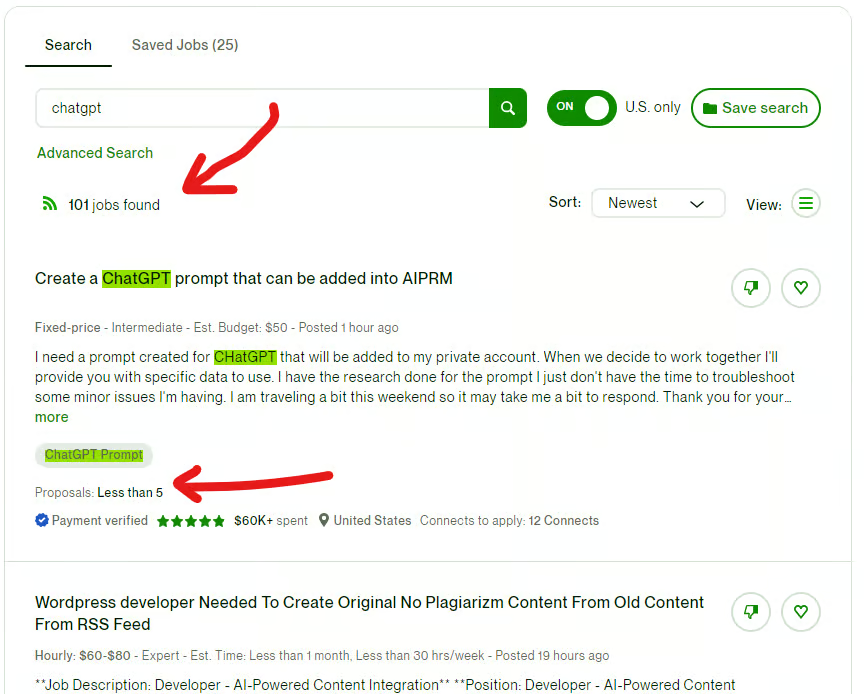
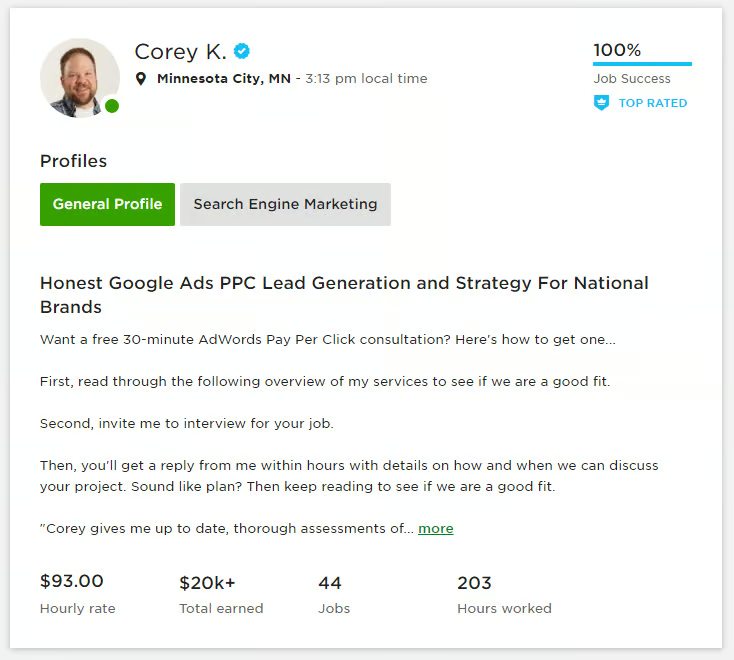
And set your expectations honestly. Your first few proposals will go nowhere. That's normal. Treat the first 10–20 as practice while you learn how clients talk about their problems.
Rough notes are fine. These feed the validation prompt below.
Path 1: Freelance It
Copy this, fill in the brackets, and paste it into your favorite AI tool. It returns 5–10 specific offers you could realistically make, ranked by which one you could test the fastest.
Path 2: Package It
Here's the shift that makes Path 2 click. Say you build financial models in Excel at your day job. As a freelancer (Path 1) you might charge $50 an hour to build them for clients. Package that same skill instead. Turn your best model into a plug-and-play template, and you can sell it for $29 over and over while you sleep. Same expertise, built once and sold many times.
Copy this into an AI assistant like ChatGPT or Claude, fill in your details, and let it propose 5 specific "build-once, sell-twice" ideas.
Path 3: Build an Audience
No prompt for this one. It's less an offer you validate and more the asset you build underneath whichever path you pick.
The third way in is the slow one: start a newsletter. It usually pays the least at the start and has the highest potential ceiling over the long term, because it's the one thing you actually own. Not a follower count you rent from an algorithm that can cut your reach overnight. An audience that's yours, one that makes your freelancing and your products compound instead of starting from a cold stop every time.
And here's why it's especially powerful for someone in your shoes. As a 50‑something professional, you've already built the skills and the stories. Your newsletter turns that hard-won experience into a magnet for the right people.
An audience also pays in more ways than one. Once people trust you, you can earn from sponsorships, affiliate recommendations, a course, a paid community, or your own services. Often several at once. That's what makes it the highest-ceiling path: it's not a single income stream, it's the soil the others grow in. (How to actually build and monetize it is its own project. That's where the next step picks up.)
The move the pros make: you don't pick this instead of the first two paths. You run it underneath them. Start collecting emails from day one, so every client, product, and idea you ever have has somewhere warm to land. That's a build of its own, though, and it's exactly where this whole thing points once you've named your direction. More on that at the finish line.
Zoom Out: The Bigger Picture
This is the part that takes the pressure off picking "the one." You don't have to. The three paths are really rungs on a ladder you climb over time. Start on one, add the next when you're ready.
- Free: your newsletter / audience
- $: a small first offer (a template, a mini-service)
- $ ×4: a course or group program
- $ ×10: premium (done-for-you or coaching)
This is Perry Marshall's "espresso machine" idea from 80/20 Sales and Marketing. In any market, plenty of folks happily buy the $1 gas-station coffee. But a slice will pay for the $50 bag of beans, the $500 home machine, even the $5,000 setup. There's always someone who wants the premium version. So each rung runs roughly 4–10× the last: same audience, ascending value. You don't build all of it now. You climb it over years.
A clear first path to start down · a short list of demand-validated offers, ranked by how fast you could test each one · and a simple game plan you can run for the next 90 days instead of staying stuck in your head.
What If You Get Stuck?
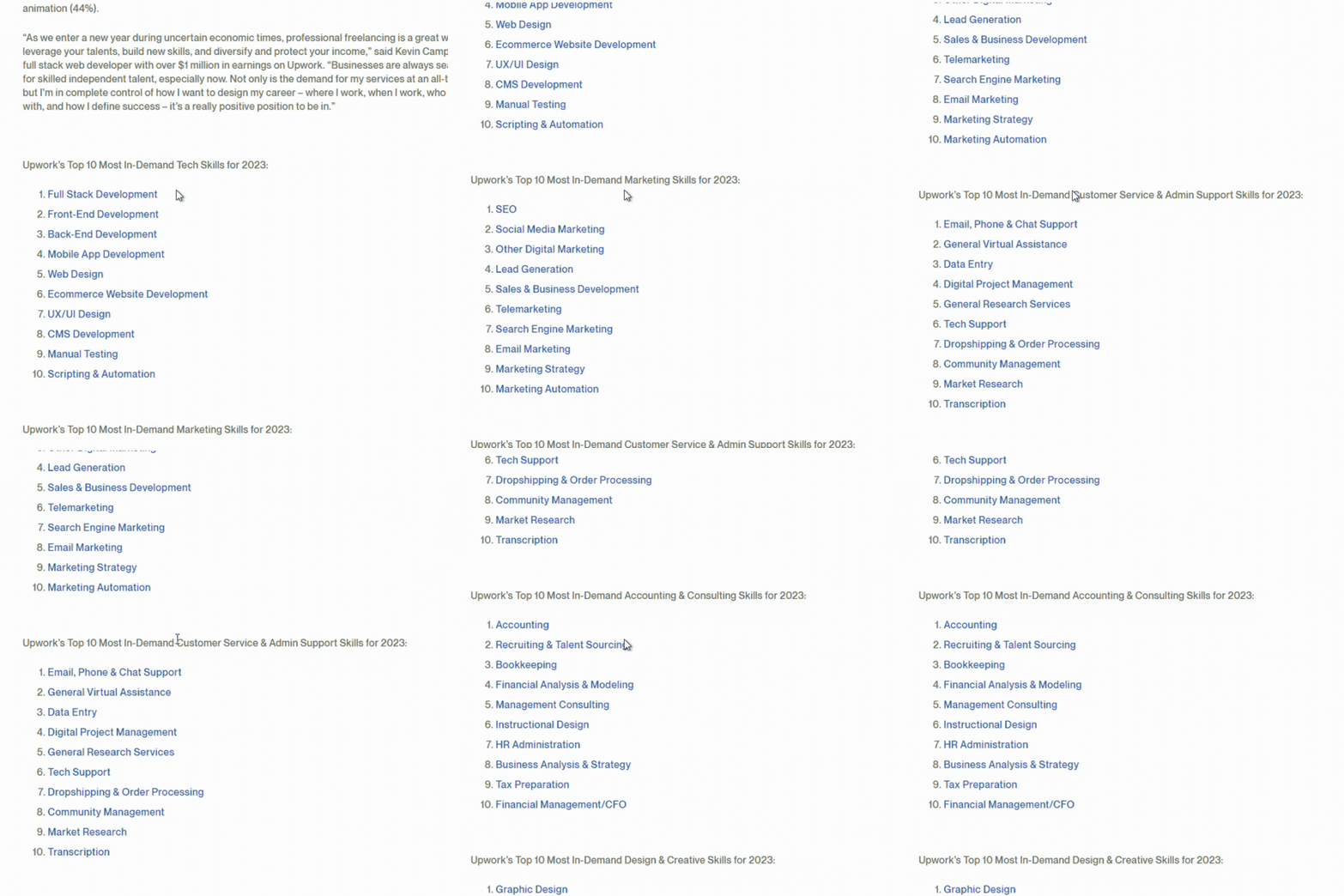
Don't have the skill yet? If you pick a path and realize you're missing a piece, that's not a wall. It's a short detour. Upwork regularly publishes lists of "most in-demand" and "fastest-growing" skills. Recent lists lean heavily toward AI-related work and automation, but they change every year, so always check the latest one.
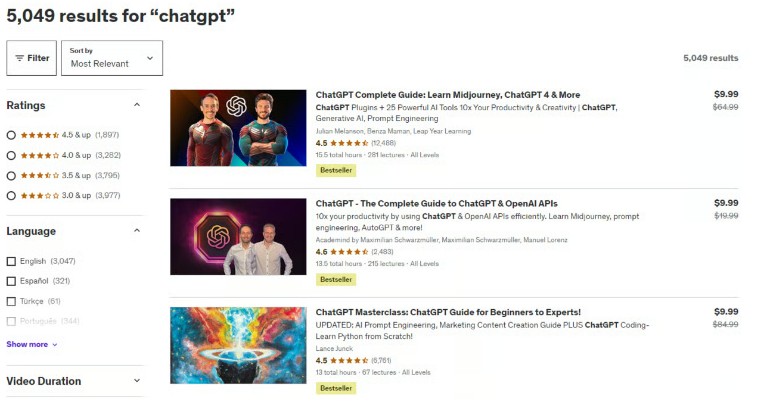
Then go learn it. Pick a highly-rated course on a site like Udemy and work through it. Many practical freelance skills can be learned well enough in a few weeks to handle beginner-level projects, as long as you practice and stay honest about what you can do. Finishing a solid course often puts you well ahead of the client who's hiring, because they usually just know they have a problem, not how to solve it.
And if the work ever dries up or you just get bored, you run the same loop again: find a skill in demand → learn enough to be useful → offer a simple, clear service. That's what keeps you future-proof.
Set the Heading: Your North Star Page
One direction. On paper. With a first step you take this week.
This is where it all lands. Pull from everything your AI handed you across the four modules and fill in the one-pager below. Short answers. Plain words. This is the document you walk away with.
Not sure what "good" looks like? Here's how it came out for two very different people. One leaned on decades of work experience, the other on a lifelong passion. Same five questions, two completely different lives:
See the difference? One reused a career, one chased a passion. Both walked out with a real direction. Yours will be its own thing. Now write it:
The Pressure's Off
One last thing, because I know what's nagging at you: what if I pick wrong?
You won't, because there's no permanent wrong here. This is a repeatable process, not a one-shot bet. If your direction dries up, or you get bored of it, or you just want a new challenge, you run the Compass again. There will always be a new in-demand opportunity waiting. That's the whole point of building this way instead of betting the house on a single hunch.
The Reinvention Loop
It's a method, not a one-shot. Run these five steps anytime you need a fresh direction.
What's Next
Now you know what. The next thing you'll need is somewhere to build it, and someone to build it for. That's an audience you actually own: a newsletter. It's the one asset no algorithm, no layoff, and no AI can take from you, and it's where every direction in this workbook turns into income that compounds.
But that's the next leg of the trip. For today, you did the hard part most people skip: you found your heading. The Golden Handcuffs Trap finally has a key in the lock.
— Corey
Do the work. Fill in the box, run the prompts, write your North Star. If you don't walk away with a direction worth building toward, email me at coreysretirement@fastmail.com and I'll refund every penny. No questions, no hoops, no hard feelings. You risked the price of lunch to stop wasting years on the wrong thing. The least I can do is take that risk off your plate.
All 7 Prompts, in One Place
Coming back to run the Compass again, or just want the prompts without scrolling the whole workbook? Here they are, in order, already filled in with your raw materials from the box up top. Copy, paste, go.
Now go find your heading. — Corey